What is Scholarly Communication?
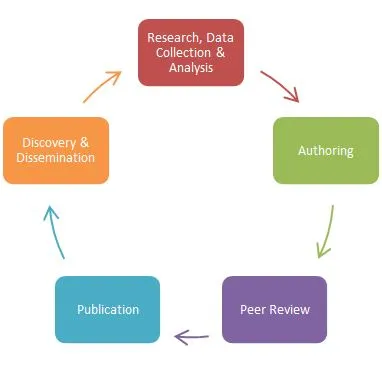
Let's look at a simple, made-up example to explain this infographic.
 1
1
Research, Data Collection, and Analysis: let's say you're a graduate student studying wildlife biology. You have a hypothesis that changes in the climate in the plains of central Canada are significantly impacting the migratory patterns and breeding frequency of snow geese.2 You go out into the field (central Canada) to make observations and collect data. You get back home and begin to analyze that data, thinking about whether it supports your hypothesis or not.
Authoring: after a lot of analysis, you determine that the data does support your hypothesis. You write about your hypothesis, your methods in collecting the data, things that succeeded or failed in your data collection process, what other wildlife biologists have said (or not said) about this topic, and what you think your data says (aka your conclusion). This forms your dissertation, required for graduation. Your professors approve of your work, and you graduate.
Your university library keeps a copy of the final dissertation, making it available in their library catalog and digital repository. But you want to engage in a conversation with other wildlife biologists. You want them to read your work and respond to it--what do they think about your methods for data collection and analysis? Do they agree or disagree with your conclusions? Do they think you missed anything? If they were to go out into the field and observe snow geese and collect data, what would they do differently?
You learn that in order to engage in that conversation with other wildlife biologists, you need to turn your paper into a work of professional scholarship (with you being the scholar). You find some peer-reviewed journals that publish papers about wildlife biology, and you submit your paper for consideration.
Peer Review: a team of wildlife biologists (aka your peers) across the field read your submitted paper and give you feedback on how to make it better:
- It's too long. Your dissertation was 100 pages which is normal length for a dissertation, but a published article in this journal can only be 40 pages. You need to reduce the length without losing important details, so you learn how to be efficient with your words
- The paper doesn't address other observations and conclusions about snow geese in central Canada
- Maybe you're the first person to every study this subject. If so, why do you think that is? Are there methodologies, observations, or conclusions from similar subjects that might help inform or support your ideas?
- Or maybe you're the 500th person to ever study this subject, and the 499 others have been studying it in just the last 10 years. You're in a new and emerging field! What do other scholars of this subject have to say about snow geese in central Canada and whether changes in the climate are significantly impacting the migratory patterns and breeding frequency of these birds? Does your conclusion build on some of their conclusions? If not, and your conclusion is brand new and different from the rest, why do you think that is? Did they miss something in their research that you included in yours? You revise your paper and submit and updated draft addressing the peer reviewers' feedback.
Publication: the peer reviewers approve of your revisions and move your paper forward to publication. Congrats! You're officially a published scholar! This means your research has a level of authority and credibility because it went through this peer review process.
Discovery and Dissemination: you want people to actually read your published paper, so you ask your university library to add it to their catalog and institutional repository. Meanwhile, you add it to your LinkedIn, Google Scholar, and ORCID profiles, and you post it in wildlife biology circles on social media.
Repeat cycle: A few years later, an up-and-coming wildlife biologist graduate student cites your work in their own research about the same topic. Their conclusion builds on the data you collected years ago, and shared in your publication. Without your data, the student wouldn't have had that base knowledge as a jumping off point. They also improved upon your methodology for collecting the data, inventing a new approach with emerging technologies. The research continually improves as researchers use each other's findings to make their own research stronger.
This cycle is a conversation of scholars communicating with one another through their research/scholarship. This conversation is referred to as Scholarly Communication.
This is a simplified version, and just one example, of how that lifecycle plays out in real life. But it provides the basis for all the complexities that we'll discuss in this blog, including:
- funding
- institutional review boards
- publishers
- copyright
- academic libraries
- tenure
- research impact
references
graphic from ACRL Scholarly Communication Toolkit↩
This example was randomly made-up after reading this article: Can Anything Stop the Explosion of Snow Geese in the Western Arctic?↩